
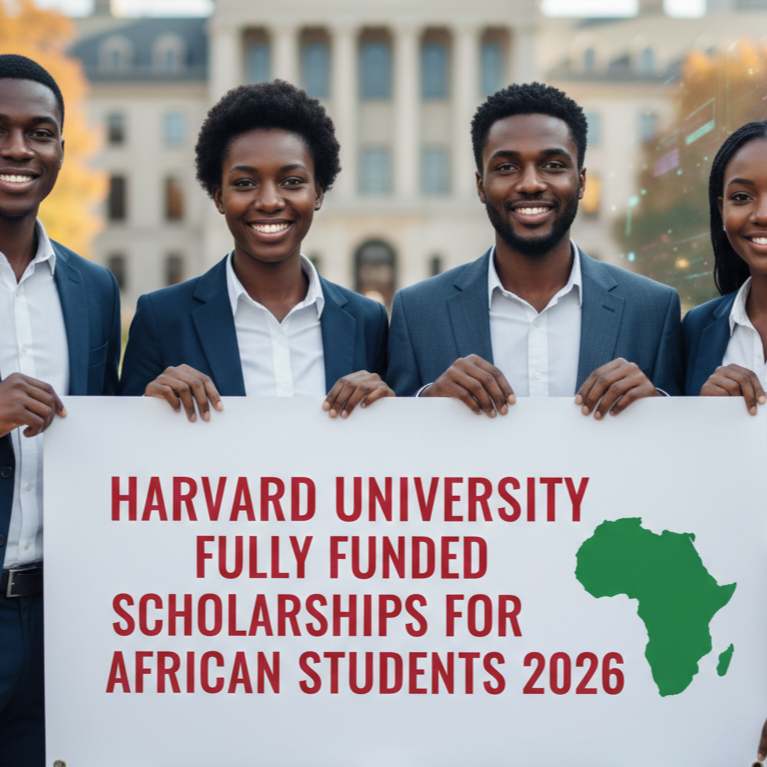
Harvard University Fully Funded Scholarships for African Students 2026
Securing an admission letter from Harvard University is a monumental achievement, but for many brilliant African students, the staggering cost of an Ivy League education can seem like an insurmountable barrier. Fortunately, as we look toward the 2026 academic year, the dream of studying at one of the world’s most prestigious institutions is more accessible than ever. Thanks to robust financial aid programs, targeted fellowships, and external sponsorships, there are numerous pathways to obtain Harvard University fully funded scholarships for African students in 2026.
Whether you are a high school graduate looking to begin your undergraduate journey, a mid-career professional seeking executive education, or a researcher pursuing a postdoctoral fellowship, Harvard offers incredible financial backing. In this comprehensive guide, we will break down exactly how Harvard’s financial aid system works, highlight specific fully funded fellowship programs available to African applicants, outline the eligibility criteria, and provide a step-by-step guide on how to apply for the 2026 intake.
Understanding Harvard’s “Fully Funded” Financial Aid System
A common misconception among international applicants is that Harvard offers “merit-based” scholarships for academic or athletic excellence. In reality, Harvard College does not award merit scholarships. Instead, the university operates on a strict need-based financial aid system. However, this system is so generous that for many African students, it translates to a completely fully funded educational experience.
Here is how the financial aid structure at Harvard College benefits African undergraduate students for the 2026 academic year:
- 100% Demonstrated Need Met: Harvard is committed to meeting 100% of the demonstrated financial need for all admitted students, regardless of their nationality. International students are eligible for exactly the same financial aid as American students.
- Zero Contribution for Lower-Income Families: If your family’s total annual income is $100,000 or below (with typical assets), your education is completely free. Harvard will cover 100% of your tuition, housing, food, and standard fees.
- Free Tuition Plus: For families earning up to $200,000, Harvard covers the cost of tuition, requiring only a modest contribution toward room and board.
- Comprehensive Coverage: For students with high financial need (which includes a large majority of applicants from the African continent), the financial aid package goes beyond tuition. It also covers health insurance, a $2,000 start-up grant for first-year students, a $2,000 launch grant in the junior year, winter clothing allowances, and travel costs (flight tickets) between your home country and the campus.
For graduate students (Masters and PhDs), funding operates differently. Each of Harvard’s graduate schools (such as the Harvard Kennedy School, Harvard Business School, or Harvard Graduate School of Education) manages its own financial aid, which is typically a mix of grants, teaching assistantships, research assistantships, and specialized fellowships.
Top Fully Funded Fellowships at Harvard for African Students in 2026
Beyond the general need-based financial aid, there are highly specific, fully funded programs explicitly designed for African scholars, researchers, and professionals. Below are the top opportunities for the 2026-2027 academic cycle.
1. The Harvard South Africa Fellowship Program (HSAFP) 2026/2027
Established in 1979 to address the educational inequalities of Apartheid, the HSAFP has evolved into one of the most prestigious fellowships for mid-career professionals from South Africa. This program offers a transformational year of study at select Harvard schools, including the Harvard Kennedy School, Harvard Law School, and Harvard T.H. Chan School of Public Health.
- Funding: This is a fully funded opportunity. It covers the complete cost of tuition for the duration of enrollment. Additionally, fellows receive a monthly stipend to cover housing in university graduate dormitories, food, medical insurance, books, and basic living expenses in the Boston/Cambridge area.
- Eligibility: Applicants must be South African citizens or legal permanent residents. You must hold a bachelor’s degree (or a four-year equivalent), possess at least five years of postgraduate work experience, and demonstrate a strong commitment to the public good and leadership potential. Priority is given to those currently living and working in Africa.
- Application Timeline: For the 2027-2028 cohort, the application portal typically opens on January 31, 2026, and the strict deadline for submission is March 31, 2026.
2. Harvard University Pre-Doctoral Fellowship 2026
For African students passionate about research, particularly in the fields of development economics, political economy, and public policy, the Harvard Pre-Doctoral Fellowship is an exceptional pathway. This fully funded research position acts as a stepping stone for those intending to pursue a PhD.
- Funding: Selected candidates receive an annual salary of approximately $50,000. The fellowship also includes full visa sponsorship arrangements, making it highly accessible for international applicants from Africa.
- Requirements: Applicants need a Bachelor’s or Master’s degree in economics, mathematics, statistics, or computer science. Strong skills in data analysis, causal inference methods, and programming (Stata or R) are strictly required.
3. Harvard Academy Scholars Program 2026
The Harvard Academy for International and Area Studies invites applications for its prestigious Postdoctoral Fellowship. This program targets outstanding early-career scholars whose work combines disciplinary excellence in the social sciences or law with a command of the language, history, or culture of regions outside of the US and Canada—making it perfect for scholars of African studies.
- Funding: Academy Scholars are awarded a generous annual stipend of $75,000. The fellowship also provides supplementary funding for conference and research travel, research assistants, and comprehensive health insurance.
- Eligibility: You must be a recipient of a PhD (or equivalent) awarded within two years of the start date (August 2026), or be an advanced doctoral candidate who will receive their degree by June 2026.
4. Fellowships at the Harvard Kennedy School (HKS)
African students applying to the Harvard Kennedy School for public policy and public administration degrees can tap into several endowed fellowships. A notable example is the Ford Foundation Mason Fellowship, which is awarded to meritorious Edward S. Mason Fellows from developing nations (including all African countries). It supports leaders dedicated to strengthening democracy, electoral reform, and community engagement in their home countries.
External Fully Funded Scholarships Accepted at Harvard
In addition to Harvard’s internal funding, many African students fund their graduate studies at Harvard through prestigious external scholarships. The Harvard financial aid offices actively work with these organizations to coordinate your funding.
- Aga Khan Foundation International Scholarship Programme: This program provides a limited number of scholarships each year for postgraduate studies to outstanding students from select developing countries (including several in East Africa). The scholarships are awarded on a 50% grant and 50% loan basis through a competitive application process.
- The Fulbright Foreign Student Program: Sponsored by the US government, this program enables graduate students, young professionals, and researchers from across Africa to study at US institutions, including Harvard. It fully covers tuition, airfare, a living stipend, and health insurance.
- Rotary Peace Fellowships: For African students pursuing master’s degrees in fields related to peace and conflict resolution at relevant Harvard graduate schools, Rotary offers fully funded fellowships covering tuition, fees, room and board, and transportation.
General Eligibility Criteria for African Applicants in 2026
While specific fellowships have unique requirements, getting into Harvard and securing general financial aid requires you to meet the following foundational criteria:
- Academic Excellence: Harvard is highly selective. You must possess an outstanding academic record, being among the top percentage of your graduating class, whether in high school or university.
- English Language Proficiency: If English is not your native language, or if your previous education was not conducted in English, you must submit standardized test scores such as the TOEFL, IELTS, or Pearson PTE to demonstrate your fluency.
- Standardized Testing: Depending on the program, you may need to submit SAT/ACT scores (for undergraduates) or GRE/GMAT scores (for graduates). Always check the specific 2026 testing policies for your targeted school, as some have moved to test-optional models.
- Demonstrated Financial Need: To access the university’s grant-based aid, you must clearly prove your family’s inability to pay the tuition costs through official financial documents.
Step-by-Step Application Process for 2026
Applying for a fully funded opportunity at Harvard is a dual process: you must apply for academic admission and apply for financial aid simultaneously.
Step 1: Apply for Academic Admission
For undergraduate programs, you will apply through the Common Application or Coalition Application. You will need to submit your high school transcripts, standardized test scores (if applicable), letters of recommendation, and personal essays. Graduate applicants must apply directly to the specific Harvard school (e.g., Harvard Business School, Harvard Graduate School of Design) using their respective online portals.
Step 2: Submit the Financial Aid Application
International applicants from Africa must complete the CSS Profile (College Scholarship Service Profile). This detailed online application assesses your family’s financial background. Harvard does not require international students to fill out the FAFSA (which is strictly for US citizens and eligible non-citizens).
Step 3: Provide Supporting Financial Documents
If your parents file income taxes in your home country, you must submit those tax documents, translated into English (an unofficial, self-written translation is usually acceptable). If your parents do not file tax documents, you must submit alternative proof of income, such as a formal wage statement, recent pay slips, or a signed letter from their employer(s) stating their annual income.
Step 4: Apply for Specific Fellowships (Graduate Students)
If you are applying to a graduate program, check whether you need to submit a separate application for internal fellowships. For example, at the Harvard Kennedy School, you must complete the HKS Financial Aid Application only after applying for admission, but before you receive your admission decision.
Essential Tips for African Applicants in 2026
To maximize your chances of winning a fully funded scholarship at Harvard, consider the following strategic advice:
- Start Early: The application process takes months of preparation. Begin gathering your transcripts, financial documents, and drafting your essays at least six to eight months before the deadlines (which usually fall between November and January).
- Tell Your Unique African Story: Harvard values diversity and unique perspectives. Use your personal statement and academic essays to highlight how your background, culture, and experiences in Africa have shaped your worldview and your future ambitions.
- Secure Powerful Recommendations: Ask teachers, professors, or employers who know you intimately and can speak to your specific strengths, leadership potential, and resilience. Give them plenty of time (at least a month) to write and submit their letters.
- Be Accurate with Financials: Never exaggerate or underreport your family’s financial situation. Provide clear, honest documentation. Harvard’s financial aid officers are highly experienced in evaluating international financial contexts and will work with you to ensure you get the support you need.
Studying at Harvard University on a fully funded scholarship is not a myth; it is a tangible reality for hundreds of international students every year. By understanding the financial aid systems, targeting the right fellowships, and submitting a stellar application, African students can unlock world-class education and join a global network of leaders in 2026. Start preparing today, and take the first step toward your Harvard journey.
